
Perimenopause and Your Hormones: A Plain-English Guide
If you've been feeling a bit off and can't quite put your finger on why, this guide explains what perimenopause is, what your hormones are actually doing, and why it can show up in so many different ways.
Last reviewed: 21 September 2026
Written by Amy-Jane Higgins, Nutritional Therapist (mANP) and RGN in Lincolnshire.
In brief
- Perimenopause is the transition leading up to menopause, and it can begin years before your periods change.
- The earliest signs are often sleep changes, mood changes, brain fog and a sense that something feels off, well before anything changes in your cycle.
- It isn't a steady decline. Oestrogen and progesterone can swing up and down unpredictably, which is a big part of why it feels so unsettling.
- Those hormones act right across your body, so symptoms go well beyond hot flushes, from sleep and mood to digestion, joints and skin.
- It's a transition rather than a diagnosis, and if something feels new, heavy or worrying, speak to your GP.
What is perimenopause?
Perimenopause is the transition leading up to menopause, when your hormones begin to shift and your body starts adjusting to a different rhythm. Menopause itself is defined as twelve months without a period, and perimenopause is everything that comes before that point.
For many women it begins in their 40s, sometimes earlier, and it often starts years before your periods change, which is why it's so easy to miss. Long before a cycle looks any different, you might notice your sleep changing, your mood feeling different, or a sense that something is off without being able to say quite what. It's a natural stage of life for anyone who has periods, and it looks different for everyone: some women have symptoms that affect their work, relationships and daily life, and others hardly notice much at all.
Your hormones before perimenopause, and what changes
For most of your reproductive life, your body has been running a fairly predictable rhythm of oestrogen and progesterone, rising and falling in much the same pattern, month after month. Perimenopause is what happens when that rhythm starts to change.
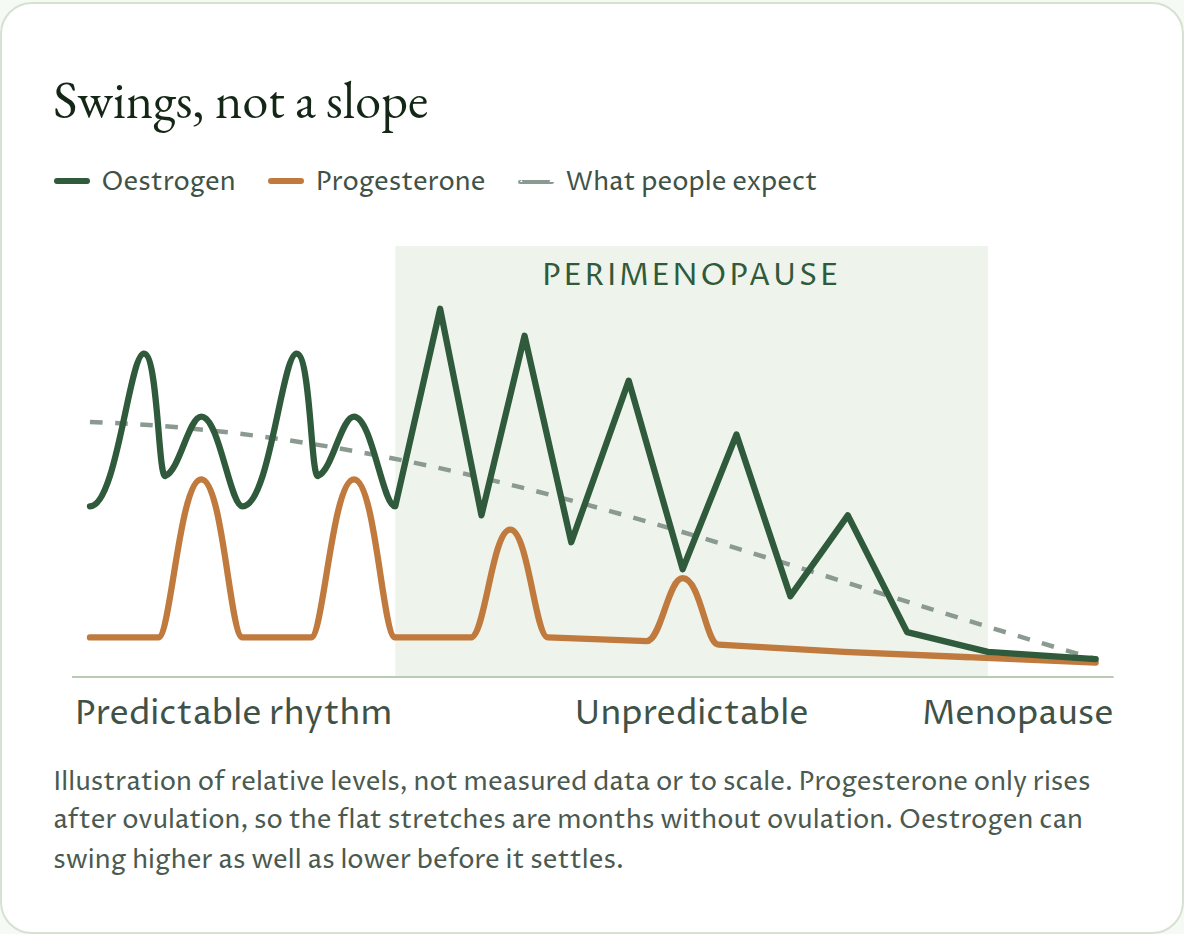
It isn't a steady decline in a straight line, it's more a system switching everything off and on again, unevenly, in whatever order it chooses. Oestrogen can be higher than usual one month and lower the next, and some months you may not ovulate at all. Without ovulation no progesterone is made that month, even if you still get a period, so progesterone often becomes less reliable first, and this can happen years before your cycle looks any different. That unpredictability, more than the hormones simply dropping, is a lot of what makes this stage feel so unsettling.
What progesterone and oestrogen actually do
Progesterone isn't only about your cycle. Its breakdown products act on the same calming receptors in the brain as GABA, which is part of why it has a settling effect, and it raises your body temperature in the second half of your cycle. It also plays a part in how your brain and bones are supported. In bone, it works alongside oestrogen: oestrogen slows bone breakdown, while progesterone is thought to support new bone formation. As progesterone becomes less reliable in perimenopause, some of that background calm can go with it, which is why sleep, mood and thinking (brain fog, memory, a sense of not feeling like yourself) are so often the first things women notice, well before any change to their periods.
Oestrogen does far more than support your cycle too. It has a hand in your energy, mood, skin, bones, brain and cardiovascular health, so when it starts fluctuating rather than declining smoothly, you can feel it in all the places it has been working.
Why the list of symptoms is so long
Oestrogen and progesterone receptors sit in tissue right across your body, which is why this is a whole-body transition rather than a single-symptom one. Symptoms are wide-ranging, and you may have several, a few, or hardly any. The earliest are often the ones people don't connect with hormones at all, such as sleep and mood changes, while changes to your periods tend to come later:
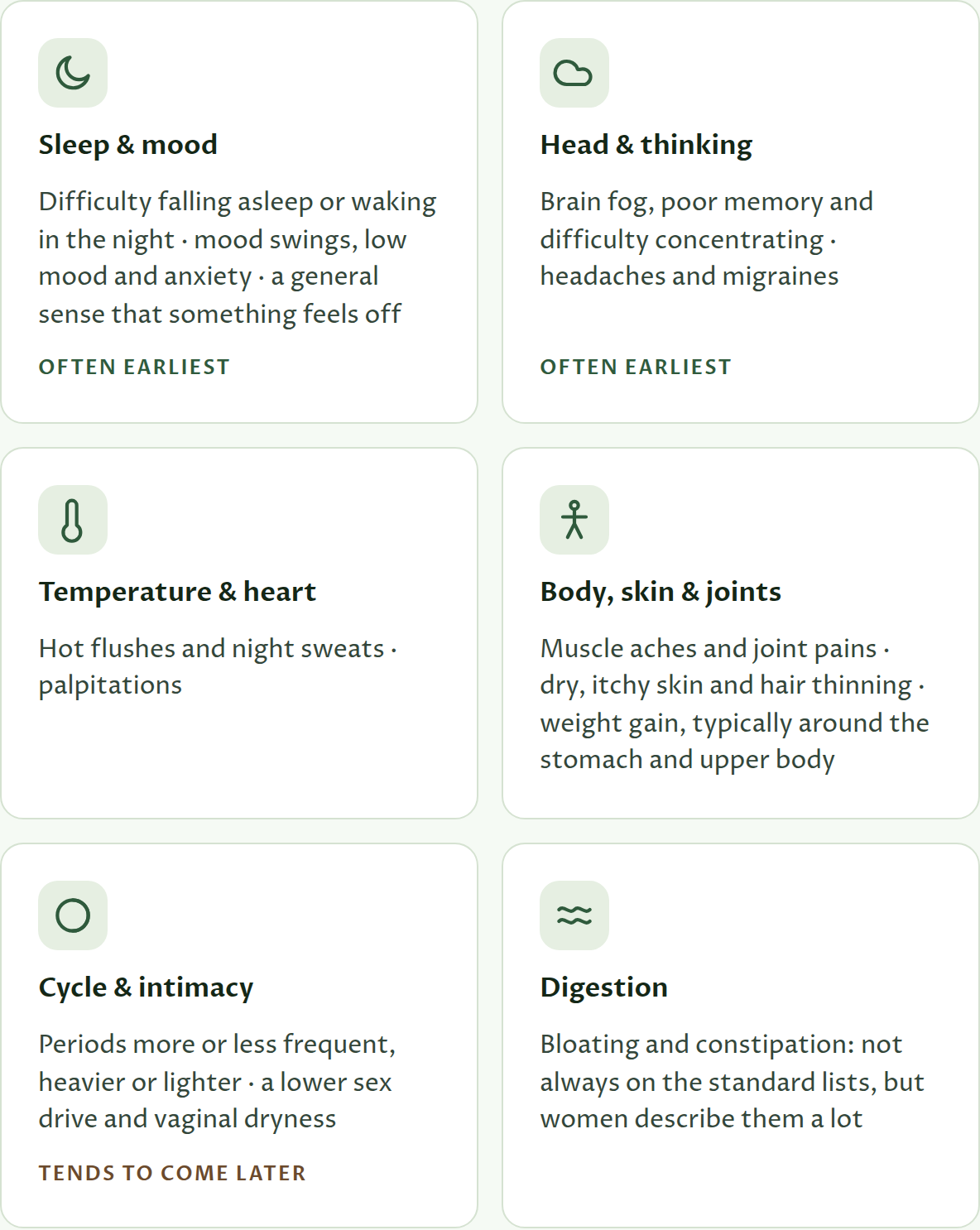
With a list this long, it's easy to lose track of what belongs where, and it can be tempting to put everything down to hormones.
A transition, not a diagnosis
Perimenopause isn't a condition to be treated so much as a stage of life your body is moving through, closer to a second puberty than an illness. I heard it described that way at a talk a while back and it has stayed with me ever since: not a decline, a recalibration.
It's worth saying the reverse too. Not every symptom you have during this stage is necessarily down to perimenopause. Things like thyroid changes, low iron and low vitamin D can look very similar, and some symptoms need looking at in their own right rather than being filed under "hormones" by default.
What supports your body through this
Because this is a whole-system shift, the foundations tend to matter more than any single change: steady sleep, a way of managing stress that fits your life, blood sugar that isn't swinging all day, food that supports what your body is asking for, and regular movement.
None of this is complicated, exactly, but I know from 25 years of nursing that simple and easy aren't the same thing, especially when you're exhausted and everything feels loud. What you need depends on what's going on for you, and there's no set timeline for feeling different, so go at a pace that suits your body.
Medical options, including HRT, are a conversation to have with your GP or a menopause specialist, and food and lifestyle can sit alongside them.
Frequently asked questions
What are the first signs of perimenopause?
Often it isn't your periods. Many women first notice changes in sleep or mood, brain fog, or a sense that something feels off, sometimes years before their cycle changes. Everyone's pattern is different.
When does perimenopause start?
For many women it begins in their 40s, though it can start earlier, and because it often starts years before your periods change, it can be hard to pinpoint. If your periods change or stop before you're 45, speak to your GP.
How long does perimenopause last?
It varies a lot from woman to woman, and because it can start years before your periods change, it can be hard to say exactly when it began. Your own experience may look quite different from someone else's.
Can perimenopause cause anxiety, low mood or poor sleep?
Yes. Sleep problems, mood changes and anxiety are among the most common early signs, and shifting hormones, particularly a less reliable progesterone, can contribute. If your mood is low or anxiety is getting in the way of daily life, speak to your GP.
Can perimenopause affect digestion?
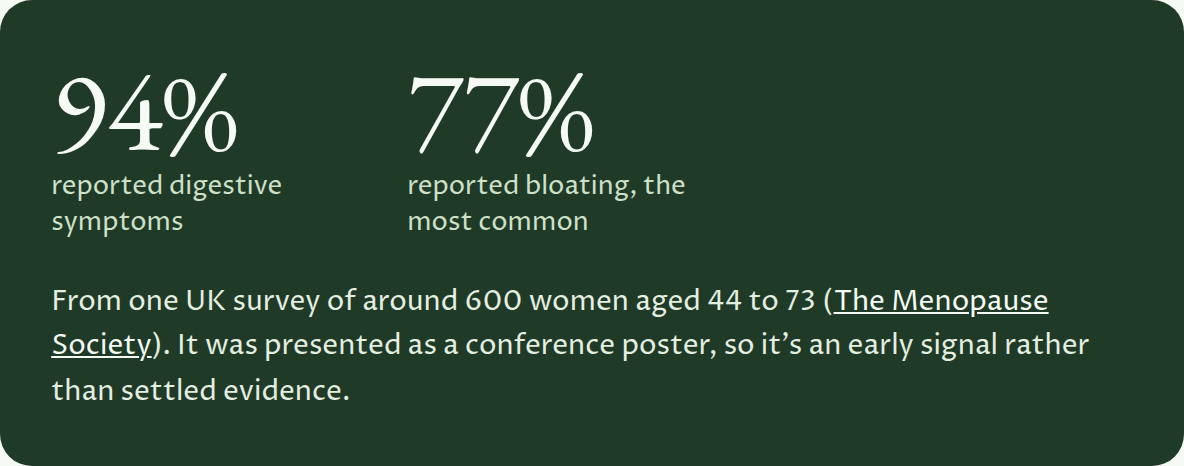
Some women notice bloating, constipation, wind or reflux. Oestrogen and progesterone receptors are found in the gut too, so changes in these hormones can affect how quickly things move through, and stress and poor sleep can add to it. New, persistent or worsening bowel changes, pain or unexplained weight loss should always be checked by your GP.
Can nutrition help with perimenopause symptoms?
Nutrition can be one part of supporting your body, alongside sleep, stress, movement and, where appropriate, medical options such as HRT. What helps depends on the person, so the starting point is understanding what's going on for you.
When to speak to your GP
This guide is general information, so please speak to your GP if:
you're bleeding more than you used to, or your bleeding pattern has changed
you've had no period for more than 12 months and you have any vaginal bleeding, even a small amount of spotting
your symptoms are affecting your work, relationships or daily life
you have palpitations, or a fast or unusual heartbeat
your mood is low, or anxiety is hard to manage
your periods change or stop before you're 45
you have new, persistent or worsening digestive symptoms, pain, or unexplained weight loss
Want to talk it through?
If you'd like to talk through what's going on for you, I offer a free complimentary call. It's a chance to talk about what has brought you here and why now, and to see whether I'm the right person to help.
Sources and disclaimer
This guide is for general information and doesn't replace individualised medical or clinical advice. Always speak to your GP about new or worsening symptoms.
The Menopause Society: Digestive health issues more common during perimenopause and menopause